Original source (online-lecture): https://www.youtube.com/watch?v=I8LbkfSSR58&list=PLbgaMIhjbmEnaH_LTkxLI7FMa2HsnawM_&index=2&t=0s (book, exercises): https://bartoszmilewski.com/2014/10/28/category-theory-for-programmers-the-preface/
1 Relation of category theory to programming
- Programming evolved from imperative, low-level (assembly) to more reusable (procedural, object oriented) languages
- Object oriented languages don't play well with concurrency, because they hide the wrong things: mutation and resource sharing between each other.
Mixing mutation and resource sharing: "Data races"
- Functional programming abstracts everything into functions, avoids mutations
- Every language has limits of what you can abstract "barrier of abstraction", even in haskell this is a very active frontier
- Here category theory becomes important: "Category theory is the higher level language above haskell, ml, assembly …"
- Highest possible level of abstraction that percolates down to even languages like javascript, assembly
2 Philosophy
- Category theory found similarities between many fields of mathematics ("essentially all areas of mathematics")
- Type theory not invented for computer science, but to push other frontiers in mathematics. E.g. to talk about paradoxes (e.g. Russels, barber paradox)
- Russel initiated type theory
- Curry–Howard–Lambek correspondence describes an isomorphism between logic, type theory, and category theory
- The human brain evolved to solve problems by dividing them into smaller problems, which is why these seperate fields evolved
without first seeing the "bigger" field/ theory.
- Maybe seperability / composability are not the properties of the true nature of the universe, but our brains are just built in a way that they have to see structure everywhere
3 What is a category
The major tools in the "Toolbox" of our brain are
- Abstractiont
- Composition
- Identity (are two things replaceable on a level of abstraction) (-> Homotype type theory is a hot topic around this)
Composition and identity define category theory
A category is a "bunch" of objects. -> We don't say a "set" of objects, because of the limitations of set theory (paradoxes, sets of sets, does a set contain itself etc.) Morphisms are arrows between the objects.
Objects and morphisms are primitives of this theory with out any properties, other than arrows are between objects.
- You can have 0 or more morphisms between objects, even uncountable number of arrows. In both directions.
- Morphisms can point from an object to that same object.
- Composition in this context means: Arrows for the "transitive closure" exist.
- Objects, morphisms and there composition completely define a category.
- For every object, an identity morphism \(id\) exists that points from an object to itself.
- \(id\) obeys left and right identity law
- Morphisms also obey associativity: \((h \circ g) \circ f = h \circ (g \circ f)\)
On the side, if objects can form a set, the category is called small otherwise large.
Categories seem similar to an algebraic group, but they are not the same:
- A group would be a category with one object
- The biggest distinction is that in categories, not everything is composeable
Relation to programing: "A function is a morphism between two types"
What are types in programming languages? Simple definition: Types are sets, functions map between sets. -> When building a category to model this, we "forget" about the set elements and view these sets as "atoms" (objects). This is the "Set" category.
We throw all information away except morphisms
3.1 Exercises Chapter 1
lambda x: x
lambda f,g:lambda x: g(f(x))
id = lambda x: x
comp = lambda f,g:lambda x: g(f(x))
plus1 = lambda x: x+1
for i in range(100):
    assert comp(plus1, id)(i) = i + 1
    assert comp(id, plus1)(i) = i + 1
I think it largely depends what the objects are? If this is not specified, you could think of a way to model the web as a category that contains one object. If the websites are objects, links are not composable, e.g. if a website A has a link to B and B has a link to C, A does not necessarily have a link to C.
- No because friendships are not transitive.
- When you define your nodes as objects and (directed) links as morphisms, and the adjacency matrix contains it's transitive closure and the main diagonal is filled.
Of course you can not represent any category with a graph like that, as multiple connections in the same direction, and infinite graphs / connections have to be possible.
3.2 Exercises Chapter 2
from functools import lru_cache
import time
from random import randint

memoize = lru_cache(maxsize=None)


def fib(n):
    if n == 0:
        return 0
    elif n == 1:
        return 1
    return fib(n - 1) + fib(n - 2)


fib = memoize(fib)

before = time.time()
print(fib(333))
after = time.time()
print("memoized fib took ", after - before, " s")

randint = memoize(randint)

print(randint(1, 100))
print(randint(1, 100))
print(randint(1, 100))

import random

# if we memoize the seed it obviously works
# because random() is deterministic
# in python we can also use Random's state:

def rand_gen(state):
    rand = random.Random()
    rand.setstate(state)
    return rand.random(), rand.getstate()


rand_gen = memoize(rand_gen)  # hash == state

state = random.Random().getstate()
result, next_state = rand_gen(state)
print(result)
result, next_state = rand_gen(next_state)
print(result)
1751455877444438095408940282208383549115781784912085789506677971125378
memoized fib took  0.0004699230194091797  s
3
3
3
0.12093689803904528
0.10506973478577686
- a and d have no side effects.
- We can map t, f to tt, tf, ff, ft so there are 4 functions
- (on paper)
4 Functions, ephimorphisms
A function is defined between sets / types where
- the set the function is defined for is the domain
- the set of reachable values is the image that is a subset of the codomain
4.1 Isomorphisms
- \(f\) is an isomorphism if \(g \circ f = id\) and \(f \circ g = id\), meaning that there is a 1-1 correspondence between the two sets.
- Isomorphisms are defined for every category: the definition above uses just composition and identity.
- Isomorphisms are invertable (If a function is mapping to values to the same output, or if it's image does not fill the whole codomain, it is not invertible)
- Injective functions map different vals to different outputs. (we "inject" in the codomain)
- Surjective functions fill the whole codomain.
- Injective + Surjective = Isomorphism
We can extend these definitions for set theory to category theory
4.2 Epimorphisms
- surjectivity in terms of categories?
- if we look at \(f : a \rightarrow b, g : b \rightarrow c\), f is surjective if it fills the whole domain b.
In category theory we can express this with composition: f is surjective (in set theory) if for any two functions from \(b\) to \(c\), the composition with f is the same. (Equality being defined by functional extensionality) \(\forall g_1, g_2: g_1 \circ f = g_2 \circ f\)
- Morphisms that have this properties are called epimorphisms
4.3 Monomorphisms
- If diffent values are mapped to different outputs, it must be true that, if we compose any \(g_1, g_2\) before f, and these compositions are equal,
\(g_1, g_2\) must also be equal (otherwise f would have to map two outputs of \(g1\) and \(g_2\) to the same output value!
- \(\forall g_1, g_2: f \circ g_1 = f \circ g_2 \rightarrow g_1 = g_2\)
- ! Mono & epic does not imply isomorphism !
5 Simple types
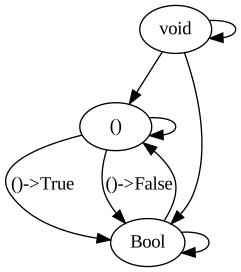
- Void correspondence to the empty set (Falsity in logic), can be never constructed
- () is the singleton, can be always created
- functions from sinlgeton type to any type enumerate that type
- other types can be built of these two simple types
6 Other categories that SET
- Zero category: no objects
- One object category: One dot with one arrow to itself
- Monoid: one object arbitrarily many morphisms to itself. This is the same as a monoid in group theory,
from the category theory perspective: The associative operation is induced by composition in \(HomSet\), and the identity element is provided by \(id\). We can always extract a "classical" monoid from a "category" monoid.
- Graphs can be categories, or made into categories (nodes are objects, links are morphisms) (called "free" categories)
- The category of all categories also exists (in this context, above simple categories become important)
- \(\leq\) is also a category (preorder). Categories that correspond to preorder are called "thin" categories: Zero or one arrows between all objects.
More specific: \(\forall a,b: |C(a,b)| = 0\) or \(|C(a,b)| = 1\) where \(C(a,b)\) is the Hom-set (set of arrows) from a to b. This category gives a good example for the fact that a morphism that is mono and epic, is not invertible.
6.1 Exercises (Chapter 3)
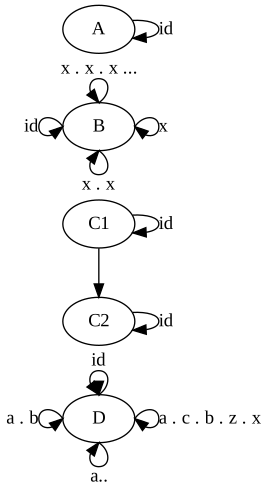
- a) The inclusion relation is a partial order. Set inclusion does not relate every set to every other set,
e.g. $ {1} \nsubseteq {2} $. But we have transitivity: \(a \subseteq b, b \subseteq c \rightarrow a \subseteq c\). b) Not too sure about c++ types but this might be a preorder. C++ has multi-inheritance right?
- wrt. &&, Bool is a monoid with True as the neutral element. Using or (||), the neutral element is False. These claims, and the associativity of && and || can be verified by writing out the truth tables, which i am too lazy to do here.